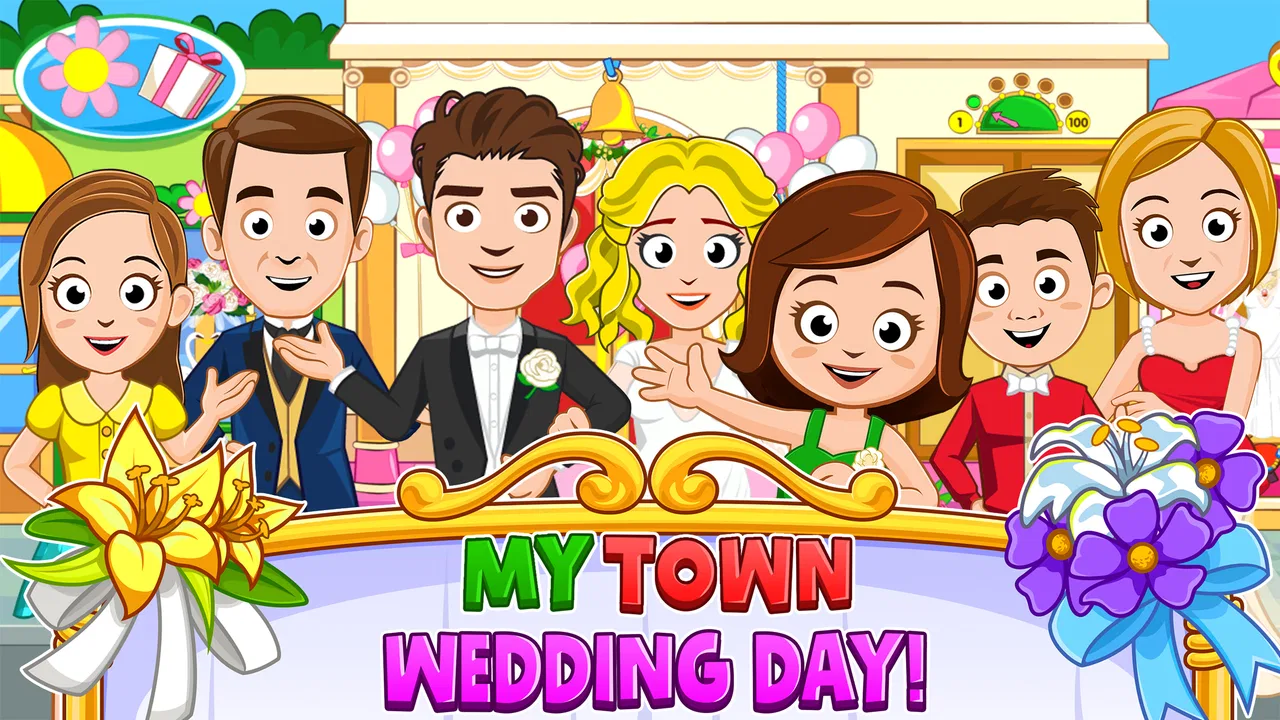
My Town : Wedding
- 4.1
- Rating
- 50.00K
- Installs
- $4.49
- Price

 Analysis by App-foxy
I approached My Town : Wedding as a relaxed, child-friendly digital playset rather than a conventional game with levels to conquer. The idea is simple: create a wedding celebration, arrange the characters and setting, and let the story come from the choices you make. That makes it a particularly approachable entry in the educational game space for children who enjoy pretend play, role-playing, and making up situations with familiar social themes.
My first impression was that the game is easiest to enjoy when nobody treats it like a test. There is no need to understand a complicated objective before beginning. Instead, the appeal comes from exploring the wedding setting and deciding what kind of event to stage. A child can focus on the ceremony, the guests, the party atmosphere, or the small stories that happen between the characters. I found that freedom more important than any single activity because it gives the player room to use imagination.
The game is made by My Town Games Ltd and is aimed at Everyone. It costs $4.49, with optional in-app purchases priced at $0.99 per item. That pricing matters when deciding who should play: it is not the same choice as a completely free title, but it also presents the main experience as a paid game rather than relying entirely on repeated interruptions. The store page shows a 4.1 average from around 676 ratings, along with over 50K installs, so it has found a modest audience among families looking for this kind of play.
You May Also Like

 Blood Strike: 2.5 Anniversary
Blood Strike’s Loadouts Turn Every Drop Into a Tactical Gamble
A close look at Blood Strike’s custom loadouts: how fast access to signature weapons reshapes its battle royale rhythm, rewards preparation, and narrows the gap between fights.

 Pandora - Music & Podcasts
Pandora’s Music Is Easy to Start, but Harder to Recover
Pandora’s strength is its low-effort path from a seed to a station. Its weak spot is how much confidence it asks you to place in connection, setup, and quiet recovery.

 8 Ball Pool
 Is Built on Rivalries, Rematches, and Routine
A close look at the rivalries, rematches, shared routines, and unanswered safety questions that turn a quick pool match into a persistent mobile community.

 Samsung Music
’s Quiet Strength Is Playing What You Already Own
Its reach comes less from spectacle than from dependable access to a personal library. That simplicity is both the app’s strongest retention engine and its ceiling.

 AccuWeather: Weather Radar
AccuWeather Review: A Quick, Clear Forecast for Everyday Decisions
For everyday plans, the best forecast is the one you can understand quickly. AccuWeather makes rain timing, radar, and local conditions easy to act on, with a few trade-offs.

 Hill Climb Racing
Why Hill Climb Racing Still Turns Crashes Into One More Run
A tiny car, a bumpy hill and one more upgrade: Hill Climb Racing keeps resurfacing because its simple chaos makes every near-miss feel personal.
More From Our News Desk
View All News


From the first tap to a successful wedding story
I find the first session goes more smoothly when I treat the wedding as a story to build, not a task to finish. Starting with just the couple and a few guests gives a new player room to notice how the scene responds before adding more ideas. From there, the most useful next step is turning those first discoveries into a simple beginning, middle, and celebration.
What to expect when the game opens
The best way to begin is to think of the screen as a collection of places and characters waiting to be arranged. I would not start by searching for a hidden winning condition. Instead, I would look around, identify the main wedding area, and tap through the visible objects and people to see what responds. This approach is reassuring for a first-time player because early progress does not depend on knowing the correct sequence.
A useful first goal is to create one complete little scene: place the couple where the ceremony is happening, bring in a few guests, and then move the story toward the celebration. That gives the player a meaningful result quickly. Even if the child does not explore every part of the game, seeing a small wedding scenario take shape provides a clear sense of accomplishment.
I also noticed that pretend-play games work better when the adult nearby avoids taking over. A parent can explain that characters and objects can usually be selected or moved, then let the child experiment. If a tap does not produce the expected response, trying a different object is more productive than turning the opening into a lesson. The game is designed around discovery, and that discovery is part of its educational value.
Making the first setup feel manageable
For a first session, I recommend keeping the setup deliberately small. Start with the couple, one or two guests, and the central celebration area. This prevents the screen from feeling busy and helps a child understand the relationship between characters, locations, and objects. Once that first arrangement makes sense, adding more people becomes a creative decision instead of a confusing chore.
It is also worth deciding what story you want before moving everything around. For example, the wedding might begin quietly, become a family gathering, and finish as a lively party. Another player may prefer to focus on preparing the couple or welcoming guests. There is no need to imitate a real ceremony perfectly. The strength of the setting is that it supports both ordinary and imaginative versions of the event.
When I review games for younger players, I pay attention to whether the first few minutes reward curiosity or punish mistakes. This one is more forgiving because rearranging the scene is part of the play. If a character ends up in an odd place, the child can simply try again. That makes it suitable for short sessions after school, a calm activity during travel, or shared play between an adult and a child.
The first successful action that gives the game purpose
The first satisfying milestone is not unlocking something or completing a timed challenge. It is making the wedding feel populated and intentional. I would move the couple into position, add guests, and then create a small sequence such as welcoming everyone, beginning the ceremony, and moving into the party. The sequence does not need to be formally recognized by the game to feel successful to the player.
This is where the educational side becomes more visible. Children practice ordering events, assigning roles, expressing social ideas, and negotiating what should happen next. If two children play together, one might arrange the guests while the other decides what the couple does. That kind of cooperation is more valuable here than chasing a score, because the game gives them a shared setting without forcing a single solution.
A practical tip is to narrate only when the child seems stuck. Asking, “Who should arrive next?” or “What happens after the ceremony?” encourages planning without dictating the answer. I found this works better than pointing out every available interaction. The game becomes a prompt for storytelling, not merely a collection of taps.
Where first-time players may become confused
The open-ended design can also be its main source of friction. A child accustomed to games with arrows, missions, or obvious rewards may wonder what to do next. There may be plenty to explore, but the lack of a strongly directed path can feel like a missing instruction. In my experience, the solution is to offer a simple story objective rather than expecting the game to supply one.
Another possible confusion is the difference between exploring and progressing. Moving a character or interacting with an object may enrich the scene without advancing a formal task. That is not a malfunction; it is the central style of play. Parents who expect a checklist should explain that the goal is to create and act out a wedding, not to finish a fixed campaign.
The paid structure may raise questions as well. The initial price is $4.49, while optional purchases cost $0.99 per item. I would make that clear before handing the device to a child, especially if the child is likely to tap through every available option. The game is easier to enjoy when the adult has already decided whether optional items are appropriate, rather than interrupting imaginative play to discuss a purchase.
How it compares with usual alternatives
Compared with wedding-themed games built around dress-up, matching, or timed tasks, this title feels less like a checklist and more like a movable story scene. That is a strong advantage for children who become bored when every action has only one correct answer. It is also a good fit for parents searching for a gentle activity that can be played collaboratively.
On the other hand, a child who wants clear goals, escalating difficulty, or frequent rewards may prefer a puzzle game or a structured simulation. Those alternatives usually make progress easier to measure. Here, the reward is the scene the player has created, so the value depends heavily on whether the child enjoys inventing dialogue and events.
It also differs from a general sandbox because the wedding theme gives the imagination a starting point. A child does not have to invent an entire world from nothing; the setting supplies a recognizable social occasion. That focus can make storytelling easier for younger players, although it may feel narrow to someone who wants many unrelated themes in one app.
Three ways to get more from the setting
One useful approach is to replay the same wedding with different roles. In one session, the child can concentrate on the couple; in another, the guests can become the main characters. This simple change keeps the setting fresh without requiring a new objective. It also encourages the player to notice details that were overlooked during the first exploration.
A second approach is to use the game for sequencing practice. Ask the child to arrange three events before starting: arrival, ceremony, and celebration. Then compare the plan with what actually happens. This turns free play into a light learning activity while preserving the child’s control over the story.
A third approach is cooperative role assignment. One player can manage where people go, while another provides the narration. Switching roles after a few minutes prevents one child from controlling the entire scene. This is a more interesting use of the app than simply handing over the device and hoping the players discover a long-term challenge on their own.
Who will enjoy it, and who should skip it
I would recommend it to children who like pretend weddings, family stories, character placement, and open-ended play. It is especially suitable when an adult wants to join for a few minutes without needing to learn complex rules. The Everyone rating also makes it a straightforward option for a broad family audience, although supervision around optional purchases remains sensible.
I would be more cautious about recommending it to players who need a strong sense of achievement after every action. If your child asks for points, stages, competition, or a clearly announced final result, this may feel too loose. The same applies to adults seeking a detailed wedding-planning simulation. The appeal is the imaginative scene, not serious event management.
Device compatibility is another practical consideration. The game requires Android 8.0 or later, so I would check the device before buying rather than assuming an older phone or tablet will run it. The current version is 7.03.09, which is useful to know when checking that the installed copy is up to date.
A realistic first afternoon with the game
For a first-time family, I would make the initial play session short and give it a simple beginning rather than asking a child to explore everything at once. After school, for example, a parent could sit nearby while the child chooses where the couple and guests should go. Once the scene is arranged, the adult can ask the child to tell the story of how everyone arrived. That turns the first few minutes into a finished activity, not an aimless tour of the screen.
If the child wants to continue, the next session can start from a different point of view: perhaps the guests are preparing for the event, or the celebration becomes the center of the story. I like this approach because it avoids the common trap of an adult demonstrating every possible interaction. The child gets a manageable first success, then has a reason to return with a new idea.
Small trade-offs that affect family use
One practical trade-off is that the game’s freedom makes it easy to share, but also means siblings may need to agree on who directs the scene. For cooperative play, I would set a simple turn-taking rule before starting: one player chooses character positions, then the other decides what happens next. It keeps the activity friendly without imposing a formal game rule that the experience itself does not require.
Another consideration is the difference between a quick distraction and a longer creative activity. If a child has only a minute or two, the open-ended format may not provide the instant payoff of a puzzle round. It is better suited to a little breathing room, when there is time to arrange the scene and tell a story. For a waiting room or a short pause, I would choose something with a clearer stopping point.
The purchase is also easier to judge if you think about the child’s habits. A child who returns to familiar pretend-play settings and invents new versions of the same event is more likely to get lasting use from it than one who quickly moves on unless a game presents fresh levels. The theme is focused, so repeat value comes from changing the story rather than expecting a new structure each time.
My final recommendation after using it
My Town : Wedding works best when approached as a digital storytelling kit. Its wedding theme gives children an immediate setting, while the open-ended design lets them decide how the celebration unfolds. I liked that the first meaningful success can happen quickly: arrange a few characters, create a sequence, and watch the child take ownership of the story.
The trade-off is that the game does not do all the directing for you. A first-time player may need a small prompt, and families expecting a conventional progression system may find the experience light. The optional $0.99 items also deserve a quick conversation before children play independently.
For a child who enjoys role-play, I think the $4.49 purchase is easiest to justify when the game will be used repeatedly for shared storytelling rather than played once and abandoned. My advice is to begin with a small ceremony, let the child discover the interactions, and then return to the same setting with a different story. The real success is not finishing a level; it is helping the player turn a simple wedding scene into a story of their own.
FAQs for My Town : Wedding
01What is My Town: Wedding about?
My Town: Wedding is a digital role-playing and storytelling game centered on a wedding celebration. Players can explore different locations, create characters, choose outfits, arrange ceremonies, and invent their own stories. It is designed as an open-ended experience rather than a game with one fixed objective, so children can freely move between scenes and decide how the wedding and related events unfold.
02Is My Town: Wedding suitable for children?
The game is generally aimed at young children and families, especially players who enjoy pretend play, dress-up, and creating stories. Its controls are simple and the gameplay is mostly non-competitive, with no requirement to win or lose. Parents should still review the app’s age rating, advertising, in-app purchase settings, and privacy information before allowing younger children to play.
03What can players do in My Town: Wedding?
Players can prepare and customize a wedding by selecting characters, changing clothing, exploring themed rooms, and interacting with objects throughout the locations. The app encourages imaginative play, allowing users to act out ceremonies, parties, family moments, and other events. Because the experience is open-ended, the available fun comes mainly from experimentation and storytelling rather than completing missions or earning rewards.
04Does My Town: Wedding require an internet connection?
Many parts of My Town: Wedding may be playable offline after the application and its required content have been installed, which is convenient for travel or areas with limited connectivity. However, internet access can still be needed for downloading the app, receiving updates, viewing advertisements, restoring purchases, or accessing certain online features. Availability may vary depending on the device and version.
05Is My Town: Wedding free to download, and are there in-app purchases?
The download and purchase model can differ between Android and iOS, as well as by region and store listing. Some versions may be paid, while others can include optional purchases, advertisements, or additional content. Before installing, check the official store page for the current price and purchase details. Parents should also enable device-level purchase restrictions if children use the device.
Pros
- Bright
- child-friendly visuals make the wedding scenes easy to explore.
- Many characters and outfits encourage creative role-play.
- Simple tap controls are suitable for younger children.
- Locations can be played in different ways without a fixed storyline.
- Offline play is useful when traveling or away from Wi-Fi.
Cons
- Some items and areas may require additional purchases to unlock.
- The open-ended gameplay may feel repetitive after extended play.
- Limited challenge may not appeal to older children or adults.
- Performance can vary on older phones and tablets.
- Frequent character movement can make precise interactions frustrating.

My Town : Wedding
Gallery